
Australian Visa Processing: The Scale, Numbers & Complexity
When we talk about Australian migration, public discussion often gravitates towards a handful of headline numbers.
- 185,000 permanent migration places.
- Net Overseas Migration.
- International students.
- Skilled migrants.
Each number matters.
But none, by itself, tells us the scale of the administrative system operating behind Australian migration.
So, here is another number:
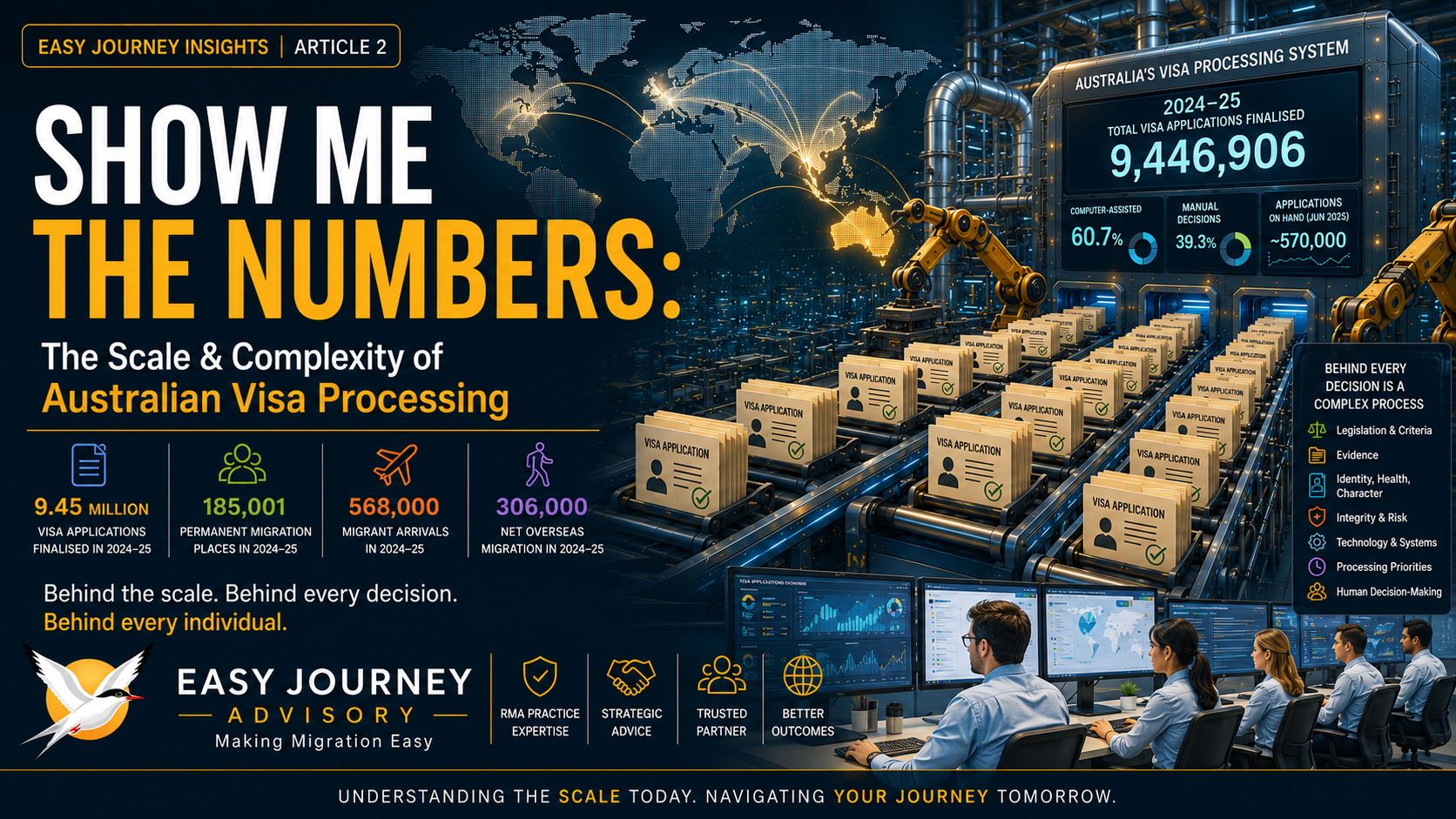
9,446,906
That is the number of visa applications finalised by the Department of Home Affairs in the Financial Year 2024–25.
More than 9.4 million visa finalisations in a single financial year.
What sits behind that number?
1. 9.4 million finalisations — but they are not all alike
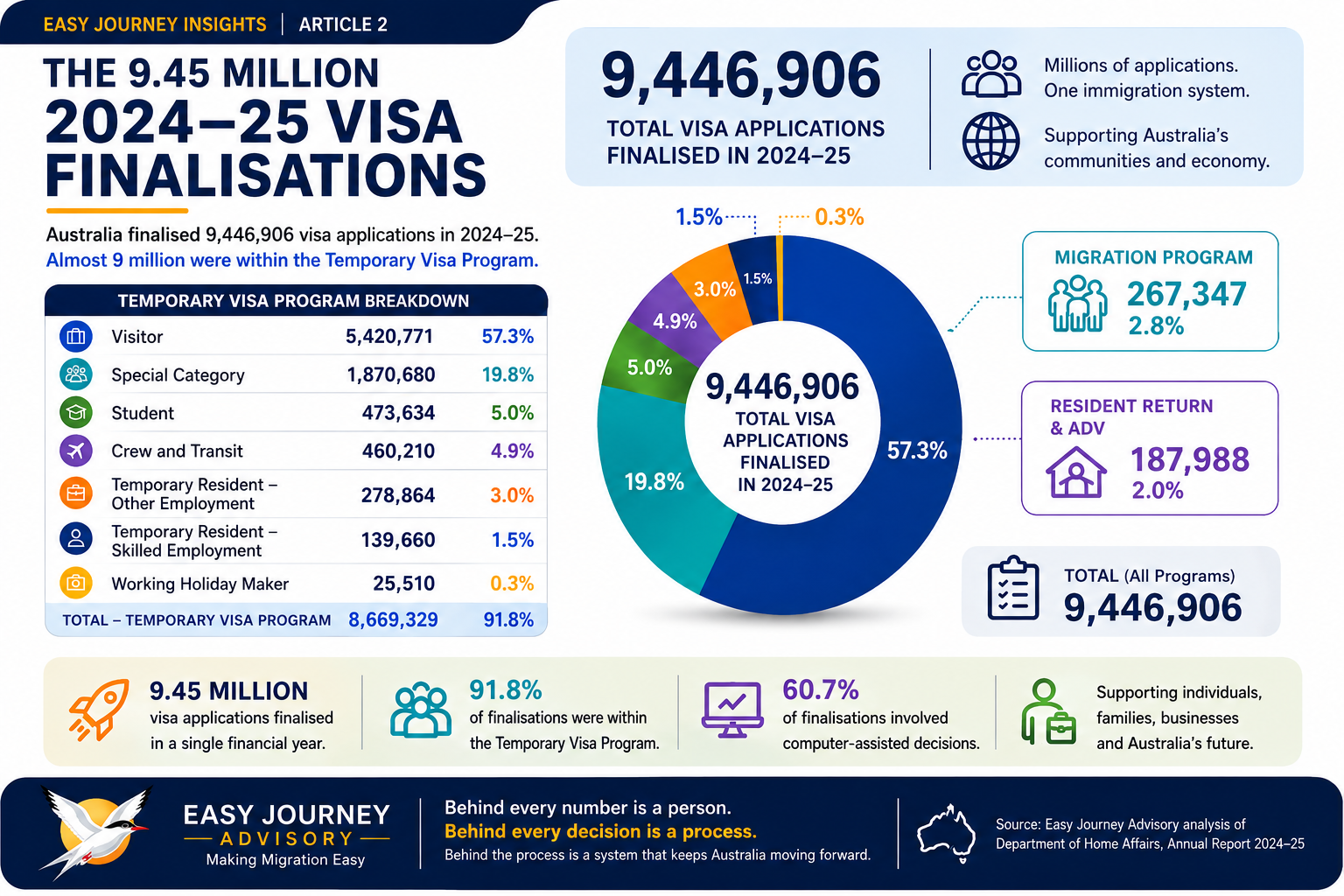
Of the 9,446,906 visa finalisations recorded in FY2024–25, almost 9 million were within the Temporary Visa Program.
They included:
- 5.42 million — Visitor
- 1.87 million — Special Category
- 473,634 — Student
- 460,210 — Crew and Transit
- 278,864 — Temporary Resident — Other Employment
- 139,660 — Temporary Resident — Skilled Employment
- 25,510 — Working Holiday Maker
Another 267,347 finalisations related to the Migration Program, while Resident Return visas (RRVs) and Australian Declaratory Visas (ADVs) accounted for 187,988.
Australia's visa system is therefore not one homogeneous caseload. It simultaneously administers mass-volume visitor and temporary-entry programs, international education, working holidays, temporary skilled migration, family migration and permanent skilled pathways.
One visa application does not necessarily represent one standard unit of work.
2. Millions of finalisations do not mean millions of Home Affairs officers manually processing applications
Technology plays a substantial role.
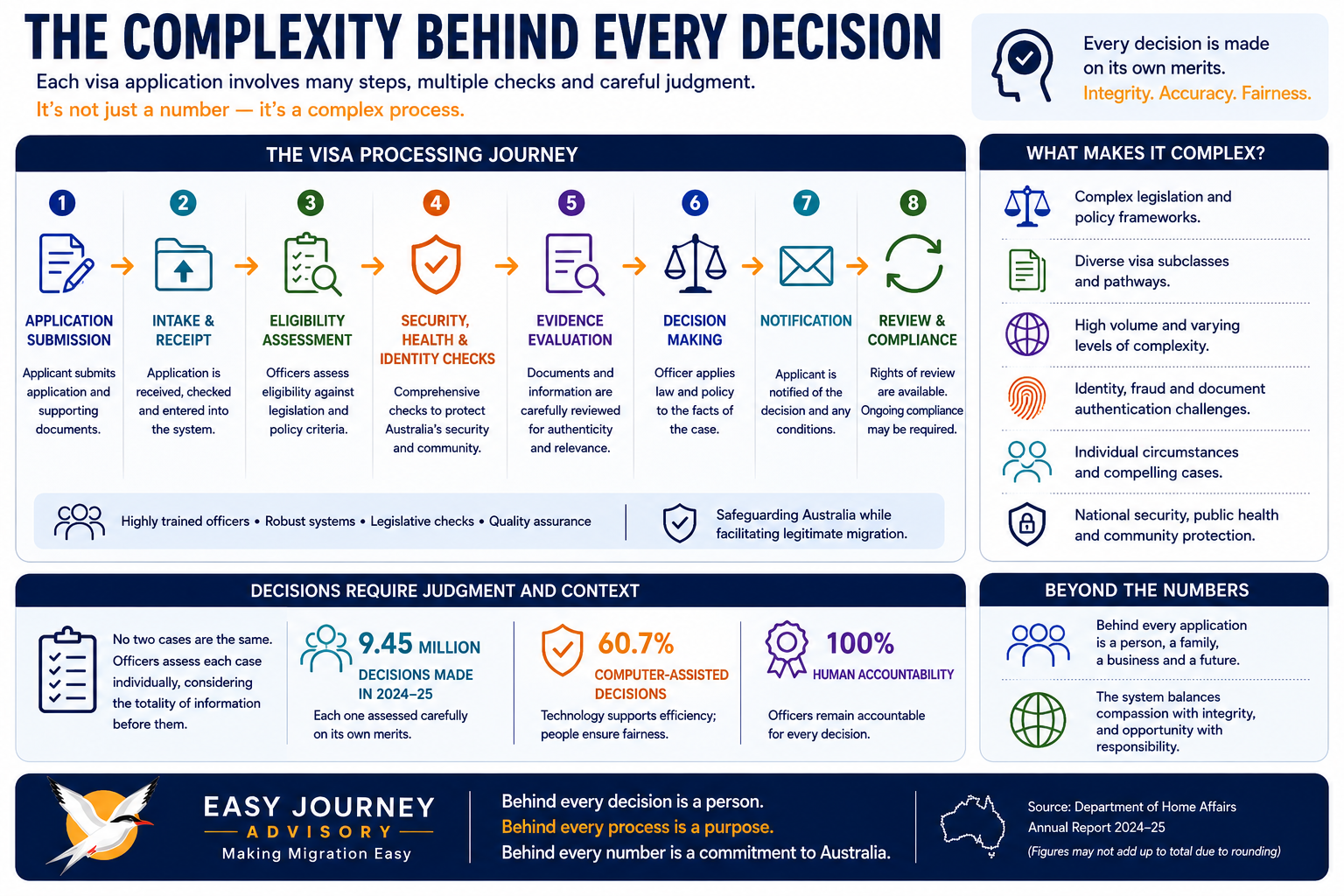
In 2024–25, Home Affairs reported that 60.7% of visa finalisations involved computer-assisted decisions.
Only low-risk visa grants can be finalised through computer-assisted processing. More complex and labour-intensive matters are diverted to a delegated officer for manual processing.
The difference becomes particularly interesting when Home Affairs measures manually finalised applications against processing staff. In 2024–25, temporary visa caseloads averaged 261.31 finalisations per processing FTE per month. For permanent visa caseloads: 42.19 finalisations per processing FTE per month.
That does not mean a permanent visa is necessarily six times harder to process than a temporary visa. The programs and caseloads are too different to support such a conclusion.
Raw application numbers alone cannot tell us how much administrative work sits behind a visa matter.
Volume tells us how much is moving through the system. It does not necessarily tell us how complex each matter is.
3. Australia was processing millions of visa applications long before COVID-19
Visitor visas provide a useful illustration.
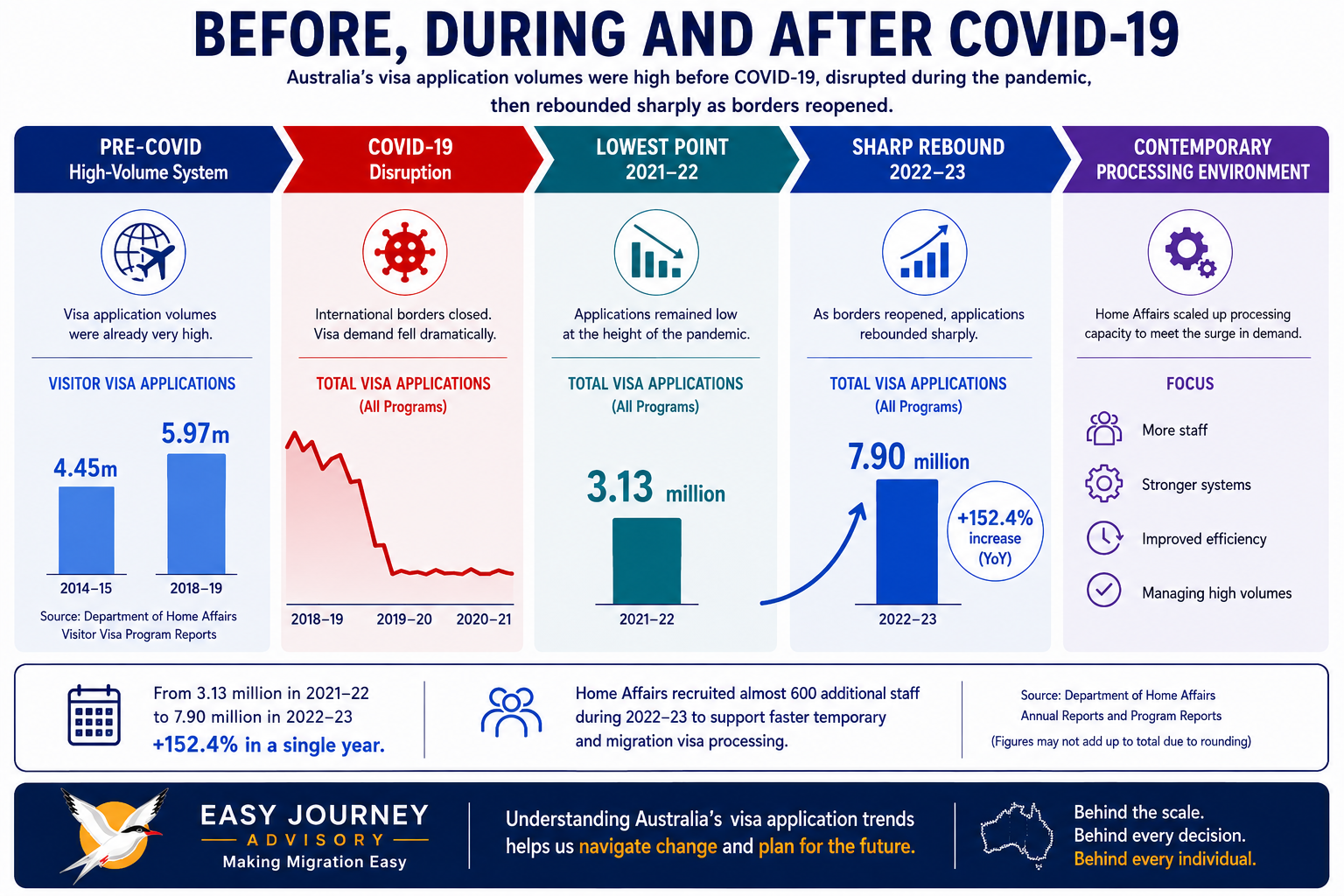
In 2014–15, Australia received approximately 4.45 million Visitor visa applications and granted approximately 4.31 million. By 2018–19, Visitor visa lodgements alone had reached approximately 5.97 million.
Then COVID-19 dramatically disrupted international movement and visa demand.
When Australia's borders reopened, the processing environment moved rapidly in the opposite direction. Home Affairs received almost 7.9 million visa applications in 2022–23, compared with approximately 3.13 million in 2021–22. That represented an increase of 152.4% in a single year.
Home Affairs also recruited almost 600 additional staff during 2022–23 to support faster temporary and migration visa processing.
4. But 9.45 million visa finalisations does not mean 9.45 million migrants
This is where migration numbers can become confusing.
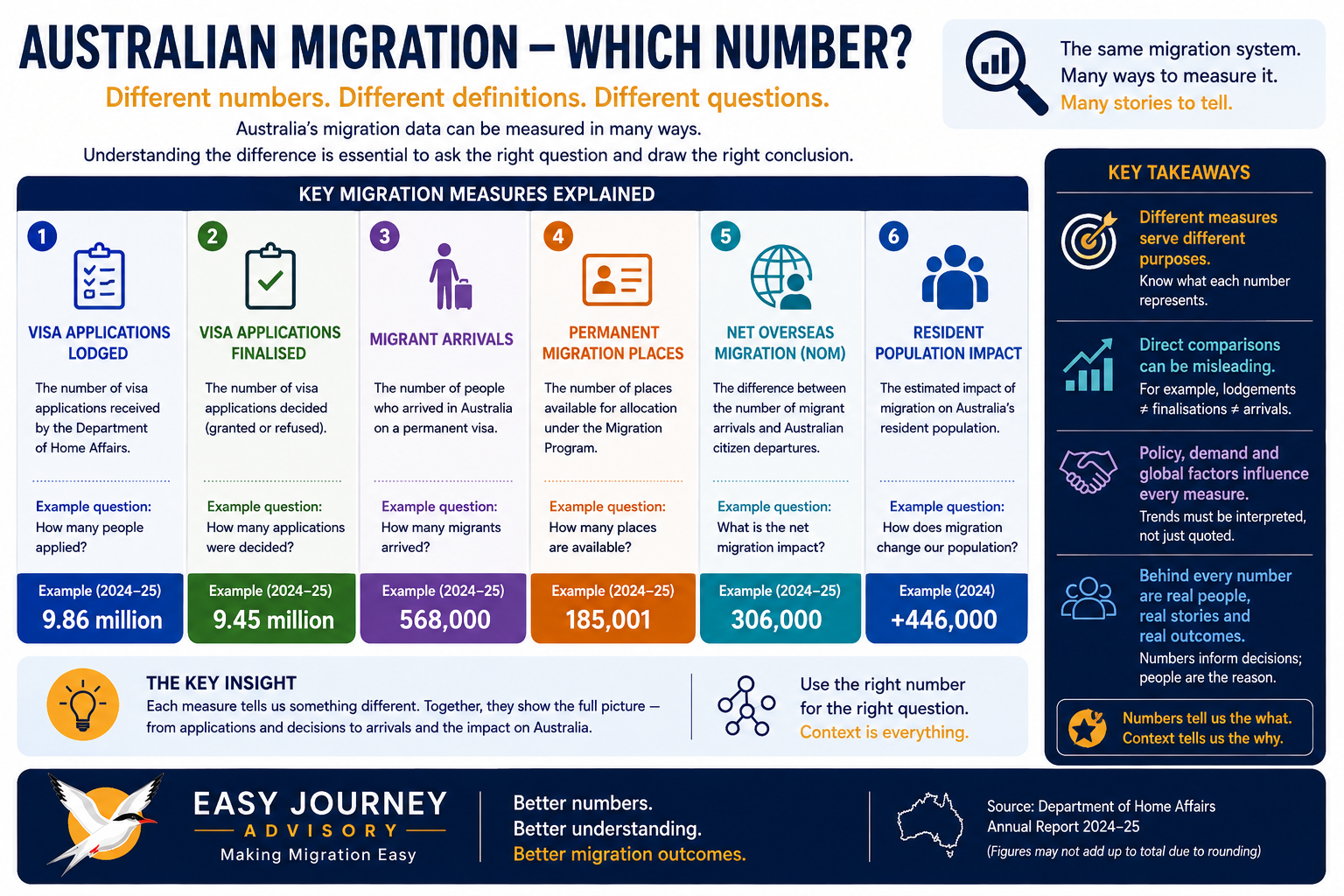
Australia's 2024–25 permanent Migration Program outcome was 185,001 places: 132,148 Skill, 52,500 Family and 353 Special Eligibility.
Now compare:
9,446,906 visa finalisations
185,001 permanent Migration Program places
These are not competing estimates of the same thing. They measure fundamentally different aspects of Australia's migration system. And neither number is Australia's Net Overseas Migration.
5. So what is Net Overseas Migration?
The Australian Bureau of Statistics recorded approximately 568,000 migrant arrivals and 263,000 migrant departures during 2024–25. The result was Net Overseas Migration of approximately 306,000 people.
Again: 306,000 Net Overseas Migration is not the same thing as 185,001 permanent Migration Program places, and neither is the same thing as 9,446,906 visa finalisations.
Visa statistics measure administrative events and statuses, while migration statistics measure people's movements and residence behaviour according to statistical definitions.
So we need to distinguish between visa applications lodged, visa applications finalised, visas granted, visa holders in Australia, international arrivals, migrant arrivals, Net Overseas Migration and permanent Migration Program places.
These measures are related. They are not interchangeable.
When someone asks, “What is Australia's migration number?” perhaps the first question should be: “Which number?”
6. What does the processing machinery behind these numbers look like?
A Department of Home Affairs Freedom of Information release provides a useful historical window.
Between June 2013 and June 2022, reported headcount within the relevant visa-processing/decision-maker job roles generally remained between approximately 2,100 and 2,450 people. For example: June 2013 — 2,351; June 2016 — 2,447; June 2019 — 2,231; June 2022 — 2,276.
These figures require caution. Home Affairs expressly states that the job-role data cannot precisely identify only those officers physically processing visa applications, and the classification changed in 2020 from “Visa Processing” to “Visa & Citizenship Decision Maker”.
The Australian National Audit Office provides another perspective. In 2021–22, 1,959 staff were allocated to support temporary and migration visa-processing functions — 1,140 in Australia and 819 offshore.
Processing capacity is not simply a question of how many people are employed.
7. Behind the numbers is an administrative system
In its examination of the Family Migration Program, the Australian National Audit Office reported that Home Affairs regarded its IT systems as a “considerable impediment” to efficient and effective Migration Program delivery.
Core systems were more than 30 years old, some programs still involved paper-based lodgement, and poor integration could result in client information being dispersed across systems.
At 27 January 2023, the Family Migration Program alone had 250,484 applications on hand.
Following additional processing capacity, Parliamentary examination recorded that the stock of permanent and temporary visa applications on hand fell by approximately 40% over the 12 months from June 2022, to around 570,000.
Behind a visa decision can sit legislation and policy, identity, health and character, documentary evidence, integrity and risk assessment, processing priorities, technology and data systems, and human decision-making. The final outcome — granted, refused or withdrawn — is only the visible end of a much larger process.
What do the numbers actually tell us?
They tell us that Australian migration operates simultaneously at two very different scales.
At the system level, it involves millions of visa transactions administered every year.
At the individual level, each application must ultimately be dealt with according to the requirements applicable to that particular visa, stream and applicant.
A system capable of finalising millions of applications does not make an individual migration matter simple.
And a visa category involving fewer applications does not necessarily make those applications easier.
From Complexity to Scale
In the first Easy Journey Insights article, How Complex is Complex?, we looked behind the visa application at the legislative and administrative framework that can shape an Australian migration matter.
This article has looked at the same system from another direction: scale.
Put the two articles together and a clearer picture emerges: Australian migration is not simply an online application form. It is a large administrative system operating within a substantial legislative framework — and every individual matter sits somewhere within it.
The numbers show us the scale. Understanding what those numbers mean for an individual matter requires looking beyond the headline.
Sources consulted
- Australian Government, Department of Home Affairs — Annual Reports, 2014–15 to 2024–25 and visa program reports.
- Australian Bureau of Statistics — Overseas Migration, 2024–25 ↗
- Australian National Audit Office — Management of Migration to Australia — Family Migration Program ↗
- Parliament of Australia, Joint Standing Committee on Migration — Migration, Pathway to Nation Building.
Figures have been drawn from Australian Government and official statistical publications. Reporting definitions, classifications and program structures may vary across years.