
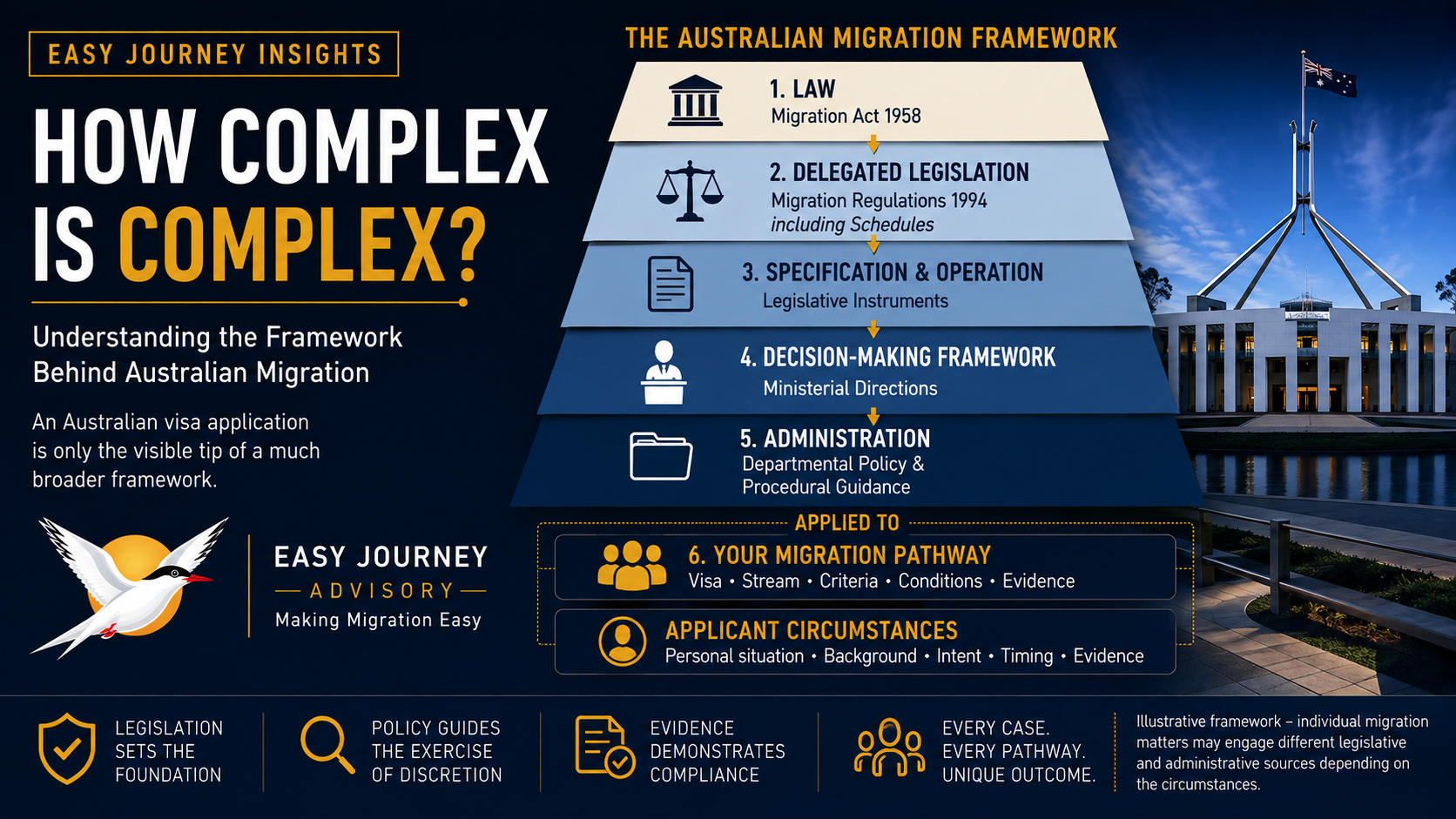
For many who have had first-hand experience, the visible part of an Australian visa application can appear relatively straightforward: choose a visa, complete the online application, answer the questions, upload supporting documents, pay the visa application charge and submit.
But the online ImmiAccount portal is only the visible tip of a much broader framework. Behind an Australian migration matter can sit Commonwealth Acts, Regulations, Schedules, Legislative Instruments, Ministerial Directions, Administrative Policy, visa subclasses and streams, visa conditions, applicant-specific criteria and documentary evidence.
Rather than simply labelling the Australian migration framework “simple” or “complex”, a more useful question is: What actually sits behind an Australian visa application?
1. It begins with primary legislation — the Migration Act 1958 (Cth)
At the centre of Australia's migration framework is the Migration Act 1958 (Cth). The Act establishes fundamental components of the migration system, including the statutory framework concerning visas, immigration status, visa cancellation, detention and removal, immigration assistance and migration agents, and numerous powers exercised under the Act.
Australian migration legislation does not consist of the Migration Act alone. Other Commonwealth Acts can form part of, or be closely associated with, the migration legislative framework. The legislation relevant to a migration matter depends upon the particular legal and factual issues involved.
2. Then come the Migration Regulations 1994
Sitting beneath the primary legislation is a substantial body of delegated legislation centred on the Migration Regulations 1994. Within the Regulations, different Schedules perform very different functions—including application requirements, visa criteria, Public Interest Criteria, Special Return Criteria, points tests and visa conditions.
Identifying a visa is therefore only one part of navigating the regulatory architecture.
3. Then come Legislative Instruments
Not every operational detail needs to appear directly in the Migration Act or Migration Regulations. The legislative framework can provide for specific matters to be specified through legislative instruments. A provision can therefore lead to another instrument specifying matters relevant to that requirement.
The issue is not reading every migration instrument. It is identifying which instruments, if any, apply to the particular pathway and circumstances being considered.
4. Ministerial Directions form another layer
Section 499 of the Migration Act 1958 enables the Minister to give written directions concerning the performance of functions or exercise of powers under the Act. A Ministerial Direction should not simply be treated as another visa criterion; it performs a particular function within the legislative and administrative architecture.
It is not enough simply to locate a document. It is also necessary to understand what type of document it is, its legal status and what function it performs.
5. Then there is Administrative Policy
The Department of Home Affairs also uses administrative policy and procedural guidance in administering Australia's migration framework. An important distinction must be maintained: policy is not legislation.
An Act of Parliament, Regulations, a legislative instrument, a Ministerial Direction and administrative policy do not have identical legal status. Nevertheless, understanding how a migration matter is administered can require an understanding of both the applicable law and the relevant administrative framework.
6. And then we get to the visa itself
Australia's visa system encompasses pathways relating to visitors, study and training, family and partners, working and skilled migration, refugee and humanitarian migration, and other purposes. Identifying a visa subclass may only be the beginning; a subclass can contain different streams or pathways involving different criteria.
7. Then apply the framework to a visa applicant
Legislation exists in the abstract. Visa decisions concern people with specific circumstances. Depending on the individual's pathway, relevant considerations can include age, English ability, occupation, qualifications, employment history, skills assessment, points, nomination, employer sponsorship, relationship evidence, financial requirements, health, character, immigration history, visa status and conditions, location, family composition, timing and documentary evidence.
Not every consideration applies to every applicant. A requirement decisive to one pathway may be completely irrelevant to another.
Which requirements apply — and which do not — to each applicant and their pathway?
8. And the framework keeps changing
There is another dimension that cannot be seen from a single snapshot of the legislation: continuing change. A review of historical Department of Home Affairs migration legislation and policy update records across FY2020–21 to FY2025–26 identified 154 published update releases—an average of approximately 25.7 per financial year.
An update release is not synonymous with a single amendment to Australian migration legislation. A release can incorporate updated material across legislation, Regulations and/or administrative policy. The data illustrate the frequency with which the migration legislation-and-policy environment is updated.
So, how complex is complex?
The framework can be understood through three dimensions:
Perhaps the real complexity lies in determining which parts of the framework apply to a particular person, in particular circumstances, under a particular migration pathway, at a particular point in time—and what evidence is required to establish that the applicable requirements are met.
Can you apply for an Australian visa yourself?
Absolutely, you can. You do not have to use a Registered Migration Agent to apply for an Australian visa. Those comfortable handling the process may choose to do so themselves.
The more useful question is: “Do I understand which parts of the migration framework apply to my circumstances, what requirements I need to satisfy, when they must be satisfied, and what evidence I need to establish them?”
Making Migration Easy
Making migration easier does not require pretending that the underlying framework is simple. It means understanding the framework well enough to identify what matters, distinguish what does not, explain the applicable requirements clearly, and help people make informed decisions about their migration journey.