
Why Visa Eligibility and Proving Eligibility Are Not the Same Thing
A visa application is not only about what you claim. It is also about what you can establish.
“I meet the requirements.”
It is an understandable starting point when considering an Australian visa.
A person may have the relevant occupation. The qualifications. Work experience. A genuine relationship. An Australian employer willing to sponsor them. Or circumstances that appear to fit a particular migration pathway.
But there is an important distinction between appearing to meet the requirements for a visa and establishing that the applicable requirements are satisfied for the purposes of a visa decision.
That distinction brings us to one of the most important — and sometimes underestimated — parts of Australian migration: evidence.
Not simply how many documents are uploaded. But what the information and evidence actually establish.
1. Eligibility is the starting point, not the finishing point
Australian visa applications are decided within a legislative and administrative framework.
At the centre of that decision-making architecture is section 65 of the Migration Act 1958. In broad terms, after considering a valid visa application, the decision-maker must determine whether they are satisfied that the applicable criteria for the visa have been met and that there is no relevant impediment to grant the visa. If the required state of satisfaction is reached, then the visa is granted; if not, it is refused.
Someone may examine the broad requirements of a migration pathway and reasonably conclude: “I am eligible.”
But potential eligibility and establishing the relevant requirements in an actual visa application are not necessarily the same thing.
What needs to be established — and what information and evidence supports it?
2. A claim and evidence of that claim are not the same thing
Consider some apparently straightforward statements:
- “I have worked in this occupation.”
- “Our relationship is genuine.”
- “I have the required qualifications.”
- “These are my circumstances.”
Each is a claim about a fact or circumstance.
But making a claim does not, by itself, necessarily establish what needs to be established for migration purposes. Depending on the visa pathway and the applicant's circumstances, different requirements may apply and different information may become relevant.
A useful way of thinking about the process is:
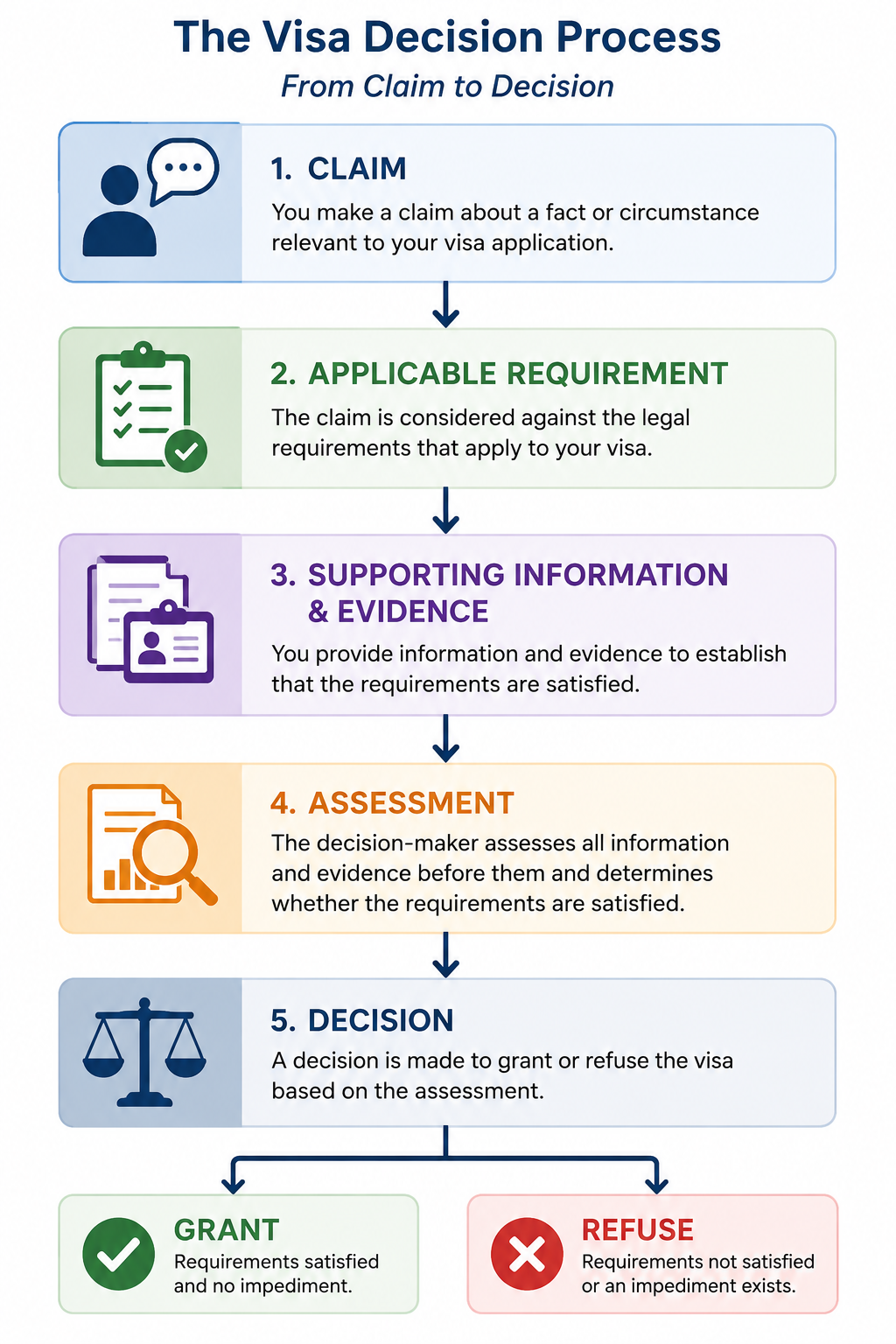
The important point is not that every application follows an identical evidentiary formula. Quite the opposite. The applicable requirements — and the information relevant to establishing them — can differ considerably between visa pathways and individual circumstances.
3. What is actually before the decision-maker matters
The Migration Act 1958 contains specific provisions dealing with information provided in connection with a visa application. Among them, section 54 requires regard to information in the application, while section 55 allows an applicant to provide additional relevant information before a decision is made.
Importantly, section 55 does not require a decision to be delayed simply because an applicant might provide — or intends to provide — further information later.
What an applicant knows about their circumstances and what has actually been placed before the decision-maker are not necessarily the same thing.
A qualification may exist. Employment may have occurred. A relationship may be genuine. A particular circumstance may be true. But the decision-making process necessarily operates on the information before the decision-maker.
That is one reason why the quality of an application cannot be measured simply by whether an online form has been completed and the Submit button has been pressed.
4. “If they need anything else, they will ask me.”
This is an assumption worth examining.
Section 56 of the Migration Act 1958 provides a mechanism through which further relevant information may be obtained and an applicant may be invited to provide additional information.
But the existence of that mechanism should not be confused with an assurance that every evidentiary gap will necessarily result in another opportunity to provide material before a decision is made.
Department of Home Affairs itself encourages applicants and sponsors to submit complete, decision-ready applications.
The possibility of being asked for more information is not a substitute for preparing an application properly in the first place.
5. More documents do not necessarily mean better evidence
Another understandable assumption is: “The more documents I provide, the stronger my application.”
Not necessarily.
The documents relevant to an application depend upon the particular visa pathway and circumstances. This means there is an important distinction between volume and evidentiary value.
Evidence may need to be considered through several different lenses:
- Relevance — Does it relate to the matter that actually needs to be established?
- Reliability — What does the information demonstrate, and how dependable is it?
- Consistency — Does it make sense alongside the other information provided?
- Sufficiency — Taken together, does the available material adequately support the matter being advanced?
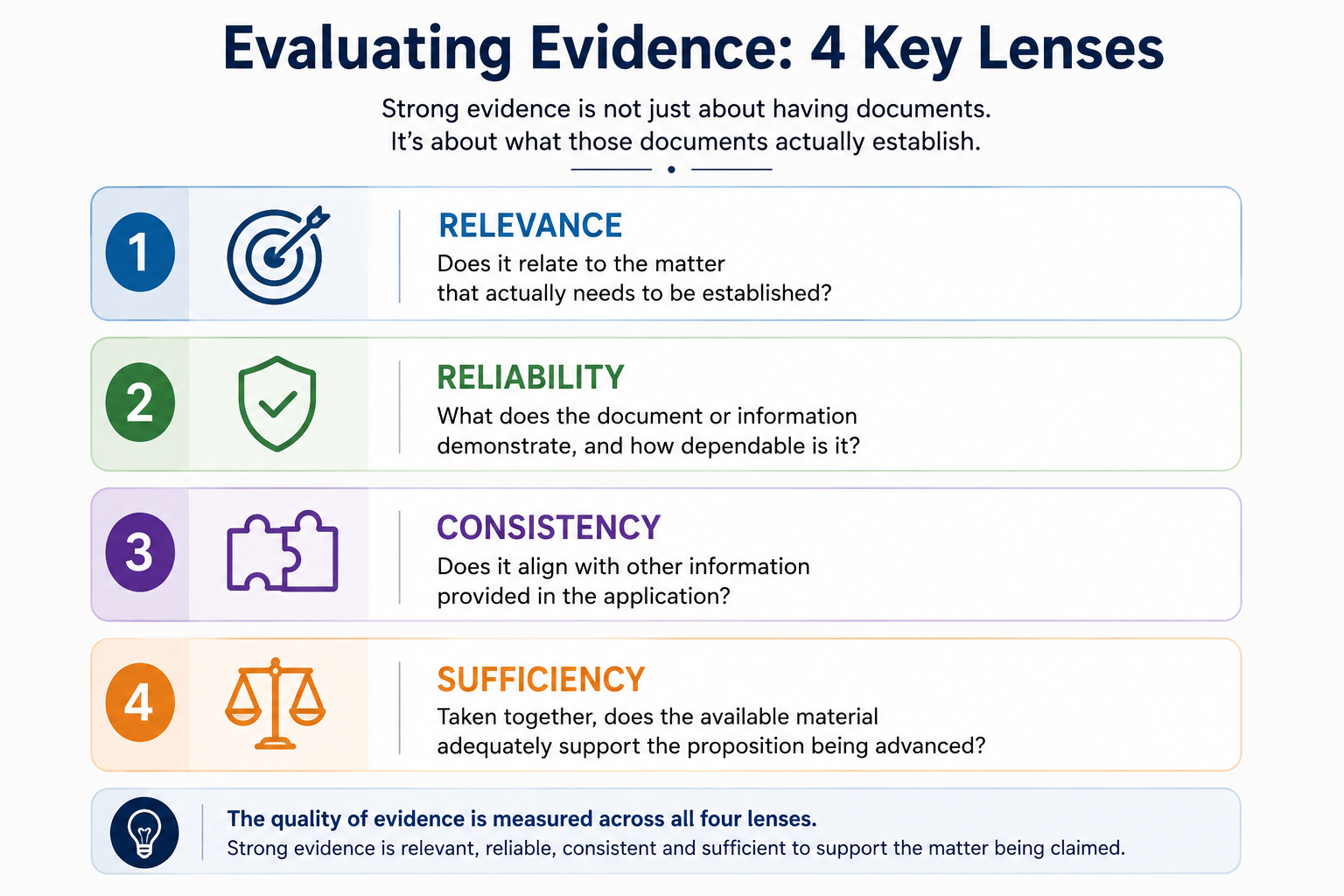
These four lenses are a useful analytical way of thinking about evidence; they are not presented here as a statutory test.
MORE DOCUMENTS ≠ BETTER EVIDENCE
The question is not merely: “How much have I uploaded?” It is: “What does the material actually establish?”
6. Accuracy and authenticity matter too
Evidence is not simply about whether a document exists.
The accuracy and integrity of information supplied in connection with an application can also matter.
Department of Home Affairs instructs applicants to provide genuine, verifiable and unaltered documents and information and cautions against false or misleading information and altered or manipulated documents.
The Migration Act 1958 and Migration Regulations 1994 also contain provisions addressing matters including incorrect information, changed circumstances, bogus documents and integrity requirements that may apply to particular visa applications.
Evidence can involve questions of relevance, accuracy, authenticity, consistency and what the material actually supports.
A document viewed by itself may appear straightforward. Placed alongside other information in an application, however, the overall evidentiary picture may be different.
7. Lodgement is not necessarily the end of the process
It can be tempting to think of a visa application as: Complete form → Upload documents → Submit → Wait.
The actual progression can be more dynamic. Depending on the application and what occurs after lodgement, further information may be requested, additional material may become relevant, mistakes may need to be corrected, or changed circumstances may need to be notified.
The application journey can therefore extend well beyond the point of lodgement.
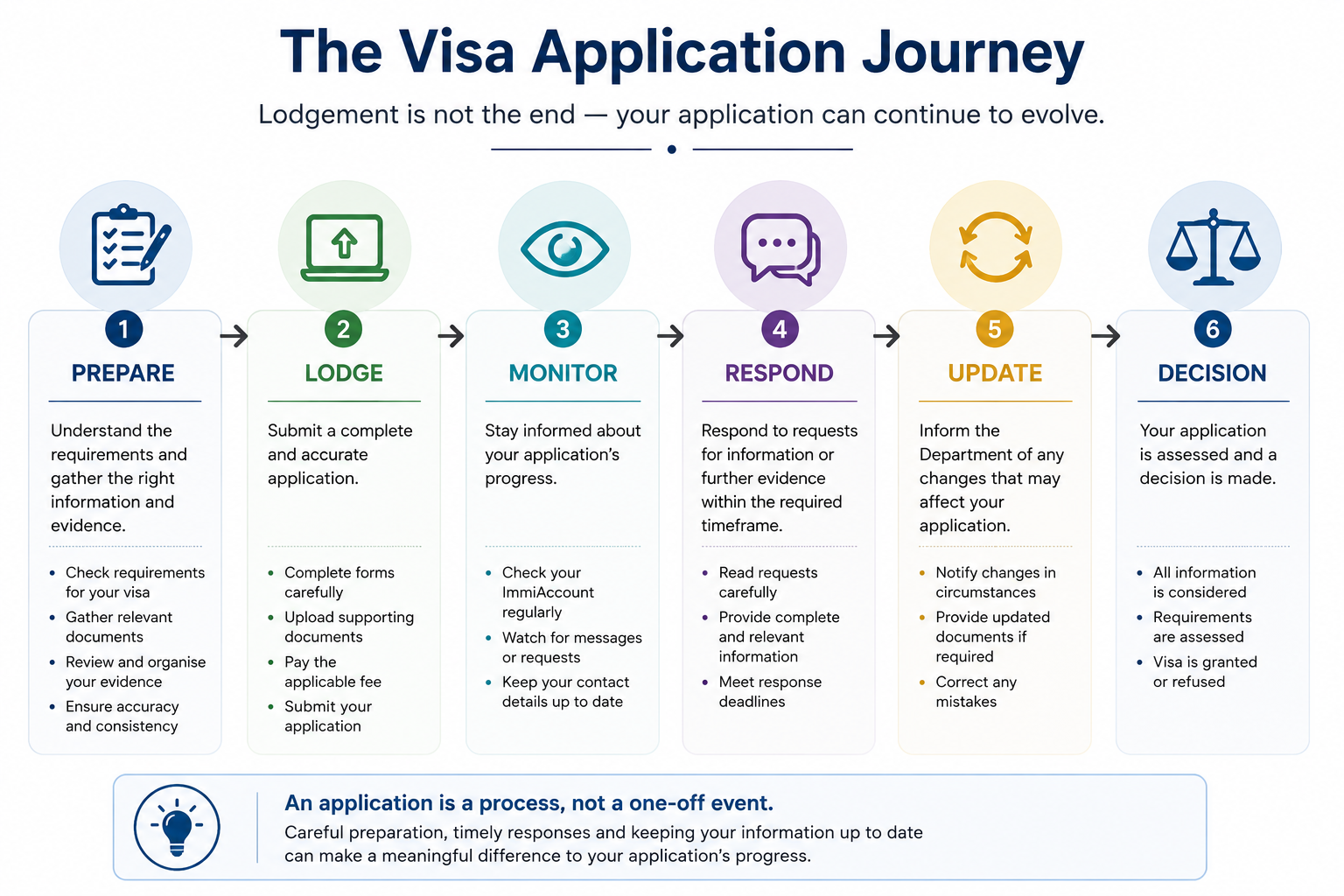
Not every application will pass through every stage in the same way. The point is simply that lodgement does not necessarily end the evidentiary dimension of a migration matter.
8. What happens when the information does not line up?
Sometimes the issue is not simply that information is missing.
Information may be incomplete. It may be inconsistent with other information. It may raise questions. Or information may emerge that requires an explanation or response.
The Migration Act 1958 contains procedural provisions dealing with certain information that may become relevant to a refusal decision. Section 57, for example, provides a framework in particular circumstances for an applicant to be given particulars of relevant information and invited to comment.
Sometimes the issue is not simply establishing the original claim — it is understanding and addressing information that affects how the application may be assessed.
Importantly, these procedural provisions do not apply in the same way to every case. Whether a particular provision is engaged depends on the information involved and the circumstances of the application.
9. Evidence does not exist in isolation
There is no single, universal set of documents that establishes eligibility for an Australian visa.
What matters depends on the visa pathway, the requirements that apply and the individual circumstances of the applicant.
A document that is important in one application may have little or no relevance in another. Even two people pursuing the same visa pathway may have different circumstances, different matters to establish and, consequently, different evidentiary considerations.
Information provided in an application can also intersect. Employment, qualifications, relationships, identity, financial circumstances and other aspects of a person's visa history may need to make sense alongside information provided elsewhere in the application.
The question is not: “How many documents do I have?”
Ultimately, the evidentiary task is about connecting the circumstances being relied upon with the requirements that need to be established. And that connection will not necessarily look the same from one application to the next.
From Framework, to Scale, to Evidence
In the first Easy Journey Insights article, How Complex is Complex?, we examined the legislative and administrative architecture behind Australian migration.
In the second, Show Me the Numbers, we stepped back and examined the enormous scale at which that system operates.
But every one of those millions of applications ultimately comes back to an individual matter: an applicant, a migration pathway, a particular set of circumstances, applicable requirements, information and evidence, and ultimately, a decision.
Potential eligibility is not the same as establishing eligibility.
So perhaps the better question is not simply: “Am I eligible?” It is:
What needs to be established — and what does the evidence actually establish?
Because a visa application is not only about what you claim. It is also about what you can establish.
Sources consulted
- Australian Government — Migration Act 1958 ↗
- Australian Government — Migration Regulations 1994 ↗
- Department of Home Affairs — policy and procedural material concerning visa applications, information and evidence.
- Department of Home Affairs — Check twice, submit once; Attach documents to your application; After you apply; Providing accurate information; Annual Report 2024–25.
This article draws on Australian Government legislation, policy and published guidance. The requirements applicable to an individual migration matter depend upon the relevant visa pathway, legislative framework and individual circumstances.